Santa Cruz island: the hub of Galápagos
Nearly every Galápagos trip touches Santa Cruz, and plenty never leave it. The island holds Puerto Ayora, the biggest town in the archipelago, the giant tortoise highlands, most of the hotels, and the day-tour fleet. This page covers what is worth your time here, which sites allow what, and how to decide between basing yourself on the island or using it as your cruise gateway.
We run Galapagos Dana Tours, so we book boats out of Puerto Ayora every week, and Las Terrazas de Dana in Mindo, where guests decompress after the islands. The short version from both: Santa Cruz is the practical center of any land-based trip, and even cruise passengers will spend their first or last night here.
Key facts
- Size: 986 km² (381 mi²), the second largest island in the archipelago after Isabela.
- Highest point: 864 m, in the green highlands behind Puerto Ayora.
- Old name: Indefatigable, from the British era. Six vegetation zones stack from the arid coast to the humid top.
- Geology: roughly 2 million years of exposed volcanic history in two series — the older Platform Series lavas (about 1.6–1.2 million years old) in the northeast, and the Shield Series that built most of the island (activity from roughly 700,000 down to about 24,000 years ago). Dormant volcano, no Holocene eruptions.
- The official provincial capital sits on San Cristóbal, but Puerto Ayora is the largest town and the real center of tourism. First-time visitors often assume it is the capital.
- Access: you fly into Baltra on the neighboring island, then cross a short canal by bus and ferry. Details in our Baltra vs San Cristóbal comparison.
Getting there and around
Baltra’s airport grew out of a WWII US air base, and since 2012 its terminal has been built as the world’s first “green” airport. From the runway it takes a shuttle, a short ferry across the Itabaca canal, and a 45-minute bus or taxi ride to reach Puerto Ayora on the south coast.
Santa Cruz is also the ferry hub of the archipelago. All inter-island speedboat routes start here: to San Cristóbal, Isabela and Floreana. Boats run roughly twice a day and take 2 to 2.5 hours per leg; since the August 2026 fare change tourists pay $50 per regular leg. Schedules, docks and the fees nobody mentions are in our ferry guide.
The visitor sites, and what you can do at each
Charles Darwin Research Station
A 10-minute walk from downtown Puerto Ayora, this is the headquarters of the Charles Darwin Foundation and home of the park’s first tortoise breeding center, running since 1965. Eggs collected from Pinzón, Santiago and Santa Cruz are incubated artificially and young tortoises are released at around five years old. Since 2021 entry requires a guide for $10 per person on top of any fee. Go in the morning, then walk to the fish market on the waterfront, where pelicans and sea lions queue for scraps.
Tortuga Bay
The best free site on the island. A paved 2.4 km path leaves from the edge of Puerto Ayora and takes 30 to 45 minutes on foot; register at the park checkpoint at the start (the trail is open 06:00 to 18:00). It lands you on two very different beaches: Playa Brava, open ocean with strong currents where swimming is prohibited and surfers go; and Playa Mansa, a protected lagoon 20 minutes further along a mangrove path where you can swim, snorkel and rent kayaks. Whitetip reef sharks rest in the shallows, marine iguanas pile up on the rocks, and turtles nest in the dunes seasonally. There are no shops, so carry water. A water taxi from the dock cuts the walk, around $10 per person.
Las Grietas
A natural canyon between lava walls filled with cold, clear water, a short panga ride plus walk from Puerto Ayora. Swimming only, no diving off the walls. Since 2021 you pay $10 per person for a mandatory guide, and the park caps it at 32 people at a time, so mornings are quieter.
The highlands: tortoises and sinkholes
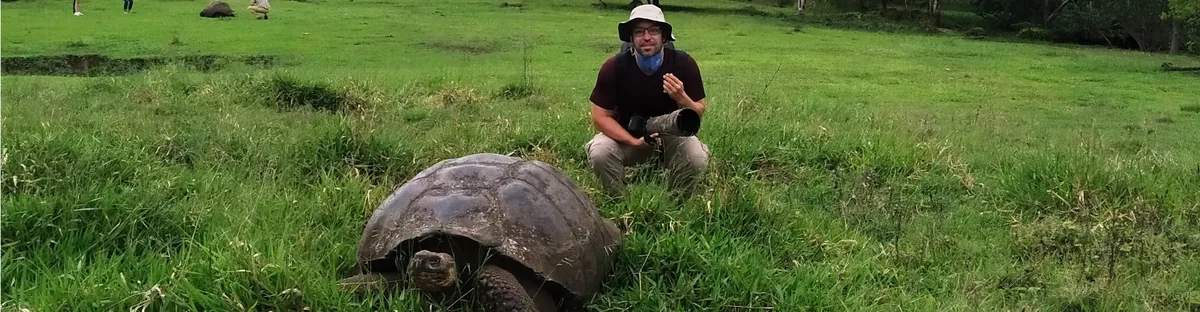
Half an hour by taxi from town, the El Chato reserve and neighboring Rancho Primicias are where wild giant tortoises wallow in muddy ponds, most reliably in the green season when the ponds fill. Both have lava tubes you can walk into, and finches, mockingbirds and short-eared owls in the scalesia forest. You can visit by taxi with waiting time, or by rented bike.
Twenty minutes further sits Los Gemelos, a pair of collapsed magma chambers rather than true craters: each is roughly a mile across and up to 280 m deep, with short rim trails and a 500 m forest loop. It is one of the best places on any island to work through Darwin’s finches: 8 of the 13 species have been recorded here.
By boat: Cerro Dragón, Las Bachas and the dive sites
Day boats from Puerto Ayora run north-coast trips to Cerro Dragón, the island’s main land iguana site (the population there was rebuilt through a breeding program after feral dogs nearly wiped it out in 1975), and Las Bachas, a pair of white coral-sand beaches that are one of the island’s main green turtle nesting sites, with a flamingo lagoon behind the sand. Both are walk-and-snorkel sites reached on half or full-day tours.
Divers head for Gordon Rocks, a submerged crater east of the island and one of the archipelago’s most reliable places to snorkel or dive with schooling hammerheads. Currents are real; not a first-dive site. North Seymour and Santa Fe are the other classic day trips, covered in their own guides.
Wildlife highlights
Giant tortoises in the wild (the eastern Santa Cruz species counts around 250 individuals and is listed as critically endangered, so the ones you meet in the highlands matter), marine iguanas at Tortuga Bay, flamingos at the lagoons behind Las Bachas and Garrapatero, lava gulls around the harbor, and brown pelicans working the fish market most mornings. For seasonal timing, from albatross to turtle hatchings, see best time to visit Galápagos.
Cruise or land-based?
Both work from here, and Santa Cruz is the one island where you honestly don’t have to choose on day one. Land-based travelers get hotels in every range, day tours to Santa Fe, South Plaza, Bartolomé and North Seymour, free sites within walking distance, and the flexibility to stay longer. Cruise passengers on almost any itinerary will start or end here because Baltra is the main airport. Our cruise vs land comparison breaks down the trade-offs honestly.
One budget note: the $200 park entry fee (foreign adults, paid on arrival) and the $20 transit card are the same whether you cruise or not. The full breakdown is in our entry fee guide.
Who Santa Cruz is for
- First-time visitors: the most services, day tours, and the shortest learning curve.
- Families: Tortuga Bay, the station and the highlands need no boat, and there are kid-friendly beaches.
- Divers and snorkelers: Gordon Rocks plus easy access to half-day boat trips.
- Travelers on 5 to 7 days who want islands plus a town to recover in. If you are counting days, our how many days guide shows what flight schedules leave you.
Last verified: September 2026