How to choose a Galápagos cruise (2026)
Roughly 85 boats cruise Galápagos, and choosing between them is the highest-stakes decision of the trip: it is usually the biggest single line item, and it is hard to change once booked. This guide gives you the decision in the right order: length first, then itinerary, then boat class, then boat. We work with every major boat in the islands, so this is the version of the pitch we give our own family.
Step 1: how many days
Cruise “days” include your arrival and departure days, so an “8-day cruise” is really 6 full days. Work backwards from that:
- 4–5 days: the minimum that makes sense. You see one region well. Our own view, and the market’s: anything shorter than 4 days wastes the flights and the $200 park fee.
- 6 days: the sweet spot for most first-timers, one solid region plus the day you arrive.
- 8 days: the full-width itineraries. Industry veterans call the 8-day the standard for a reason: it is the only length that combines two regions and covers the majority of the headline species.
- Longer: 15-day combined itineraries exist but are niche. If you want more Galápagos after an 8-day cruise, add land-based days instead.
A practical split for travellers with two weeks in Ecuador: 5–6 days on a boat, then 2–3 land-based days for the highlands, Tortuga Bay and the free sites. Our how many days guide does this arithmetic for different trip lengths.
Step 2: which region (the A/B routes)
The park splits the islands into zones and licenses fixed itineraries, which is why boats advertise “Route A” (east and south) and “Route B” (west and north):
- East/south itineraries: Española (albatross, in season), Floreana (Devil’s Crown, Post Office Bay), South Plaza, Santa Fe, plus the central classics. Best for: albatross season, gentler seas, shorter crossings.
- West/north itineraries: Fernandina and west Isabela (flightless cormorant, penguins, whales in season), Genovesa (the bird island), sometimes Santiago and Bartolomé. Best for: the geologically youngest, wildlife-richest islands, penguins, and cooler-season marine life.
- The centre (Santa Cruz, Bartolomé, North Seymour, Mosquera) appears in almost every route, because that is where the airport sits.
The honest rule: west for cormorant, penguin and volcanic drama; east for albatross and the classic landings. Neither is “better”; the boats that run 8 days effectively do both halves. Genovesa and Española cannot be reached on land-based trips, which is the argument for a boat in one sentence. We break this down further in cruise itineraries explained.
Step 3: boat class, and what your money actually buys
The fleet splits into rough tiers, and the price is driven by guide ratio and cabin quality more than by “stars”:
- Budget yachts (16 passengers, older boats): the cheapest way onto the water, from around $1,000–2,000 per person for 4–5 days and from roughly $300–400 per person per night. Spartan, lively, guides work hard. Cabins are small; the wildlife is identical to the luxury boat’s.
- Mid-range (16 passengers, newer or renovated): from roughly $400–600 per person per night; 5-day cruises cluster around $1,800–3,000, a week from $2,000–4,500. This is where most of the well-run 16-passenger catamarans sit, and where we send most guests.
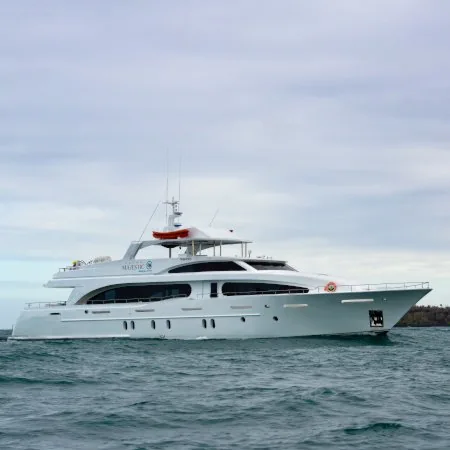
- First/luxury (16 passengers, high-end, or small ships 40–100): $600–1,000+ per person per night; luxury 8-day trips run from about $5,000 and the top suites well beyond, with all-in trip totals (flights, fees, tips) for luxury reaching $7,500–12,000 per person. What you pay for: space, food, dual guides, and amenities like kayaks and wetsuits included.
One number matters more than most marketing: the guide ratio. The park caps all boats at 16 guests per guide, but the top boats run one guide per 8–12 guests, which means smaller landing groups and a guide in the water with you when you snorkel. If you compare two boats at similar prices, the guide ratio is usually the real difference.
Catamaran or monohull is the last filter: catamarans are steadier at anchor and in the channels, which matters more than any amenity if you sleep poorly on boats. We compare them in catamarans vs monohulls.
Step 4: when, and the price of when
Season moves the price as much as boat class does:
- Cheapest: September (the low point of the year), with May, early June and early December also soft. The trade-off in September is rougher sea.
- Most expensive: August (the peak of family season), then Christmas–New Year and July.
- Shoulder strategy: April–May and October–November combine decent prices, good wildlife and calmer water than the deep dry season.
What the price does and does not include
Included: cabin, all meals, all guided excursions, snorkel gear on most boats, airport transfers in the islands. Not included: flights (roughly $400–550 round trip from the mainland), the $20 transit card, the $200 park fee per adult, alcoholic drinks, wetsuit rental on some boats, and gratuities (budget roughly $10–15 per guest per day for the guide, plus a similar pool for crew). Our cruise costs explained page itemises all of it.
The mistakes we see
- Booking the boat before the dates (availability, not preference, decides in high season).
- Paying luxury prices for a 4-day trip: the per-day premium is highest on short cruises; length is where mid-range beats luxury on value.
- Ignoring the itinerary to save money, then realising the albatross (or the cormorant) was on the other route.
- Choosing a big ship for seasickness reasons, when a catamaran’s stability is the better fix.
- Forgetting the fixed costs: add roughly $700–900 per person on top of any cruise quote for flights, fees and tips.
The one-paragraph answer
If you want the decision made: 6 days, mid-range 16-passenger catamaran, west route if you travel June–November or east route if December–May, shoulder-month dates if you can. Book 3–6 months ahead for high season; grab last-minute discounts if your dates are September–November. Everything else on this page is how to justify that to yourself.
Book early or wait? Both are honest answers. Reserve early and you get your pick of boats, cabin categories and itineraries, and you will not be locked out when the popular routes sell out. Wait for a last-minute window and you can land a genuinely good deal on whatever still has space. The trade-off is simple: early booking buys choice, late booking buys price. We tell guests to decide which one they value more and then commit to it.
Traveling alone? Prices are built on double occupancy, so solo cabin use usually carries a supplement, and agencies sometimes pair same-gender solo travelers to share. A few boats dodge the supplement entirely: the first-class catamarans Treasure of Galapagos and Elite each have a dedicated single cabin at no extra cost — a genuinely rare find in Galápagos. Last verified: September 2026
After the islands, the cloud forest — Las Terrazas de Dana, Mindo.