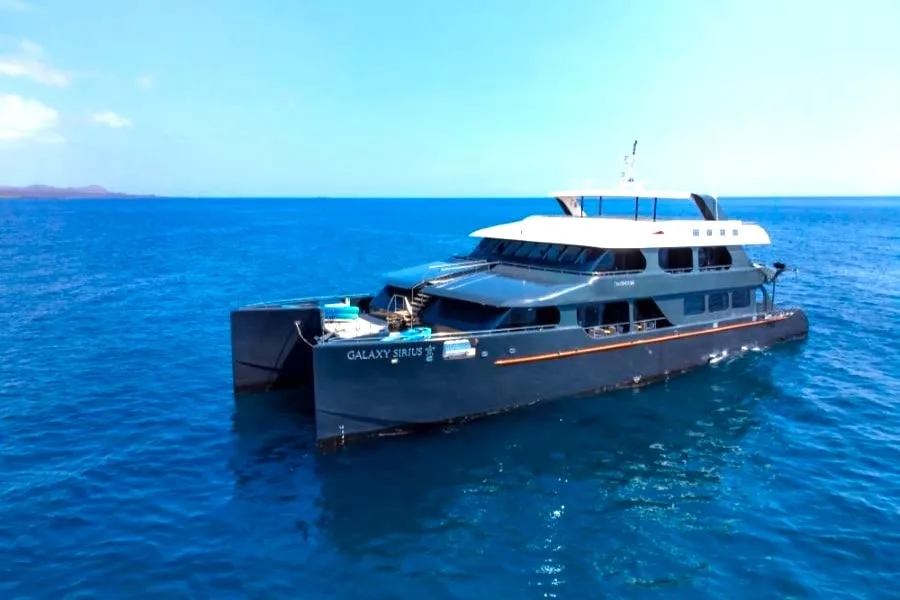
Catamarans vs monohulls in Galápagos: which hull to book
Boat class gets all the attention, but for a lot of travellers the hull type decides more of the trip’s comfort than the star rating: how you sleep at anchor, how the channel crossings feel, how much deck you get for 16 people. Here is the honest comparison, without the sales pitch for either side.
The stability question, answered
Catamarans are the steadier platform in Galápagos conditions, and it is not close. Two hulls resist rolling at anchor, which is where you spend your nights, and they dampen the chop in the channel crossings. The industry knows it: anti-seasickness advice for Galápagos starts with “choose a catamaran” for good reason. Monohulls, especially older budget yachts, roll more at anchor and pitch more underway. The dry-season months (July–October), when the Humboldt current kicks the channels up, are where the difference is most felt; in the calm warm season, the gap narrows.
If you know you get seasick, the honest sequence is: catamaran first, mid-ship cabin second, warm-season dates third, and medication regardless (read our seasickness guide).
Cabins and space
- Catamarans: wider beam means cabins spread across both hulls and the deckhouse, so most have real beds (not bunks), private bathrooms as standard, and lounge/dining space that never feels crowded with 16 guests. The trade: hull cabins can sit lower to the waterline, and the mid-ship “least motion” cabin is often the widest one, not the most central.
- Monohulls: cabins run down a corridor, so they are narrower and more vertical; on budget boats you will find bunks and shared bathrooms at the bottom of the range. On the other hand, some monohull designs put cabins on a single quiet level midship, which is the best-riding spot on any boat.
The sailing-yacht romance question, since someone always asks: the classic three-mast sailing ships in the fleet are monohulls, and they are magnificent on deck and a bit more lively at anchor than a cat. If the sails matter to you, accept the trade knowingly.
Price, 2026 reality
Hull type alone does not set the price; class does. But there are patterns:
- Mid-range 16-passenger catamarans dominate the value band: from roughly $400–600 per person per night, and a solid 5-day cruise from around $1,800–3,000.
- Budget boats are mostly monohull yachts: from around $300–400 per person per night.
- Luxury exists in both formats: high-end catamarans and expedition ships both push past $600–1,000 per person per night.
So the practical version: at the same price point, a catamaran usually gives you more cabin comfort and less motion; a monohull usually means an older boat at that price unless you are paying ship prices.
Deck life and the panga logic
Both formats of 16 guests do the same landings (park rules make the excursion experience identical), but the on-board rhythm differs. Catamarans spread people out: nets and trampolines forward, sun decks aft, shaded cockpit. Monohulls concentrate the social life: one deck, one dining table, and by day three you know everyone. Travellers genuinely split on which they prefer; extroverts often come back asking for the monohull they “hated” at first.
Water access for snorkelling: catamarans typically have swim platforms or easy stern access; monohulls often use the panga for everything, which adds a ladder-and-panga step to every snorkel. Minor, but it adds up over a week.
The one-line decision
Seasickness-prone, travelling with kids, or booking July–October: catamaran. Budget-first, or you want the social boat, or you are set on a sailing ship: monohull, and pick a midship cabin. Whatever you choose, book the boat for its guide ratio and itinerary first, hull second; a bad route on a stable boat is still a bad route. Our how to choose a cruise guide has that logic in order.
Boats in the Dana Tours inventory, by hull type
We work with all of them, and each boat’s own page states its type — the short list as of September 2026:
Catamarans (18): Treasure of Galapagos, Anahi, Archipel I & II, Cormorant I & II, Seaman Journey, EcoGalaxy, Alya, Ocean Spray, Millennium, Endemic, Elite, Petrel, Reina Silvia Voyager, Galaxy Sirius, Hermes, Monique.
Motor yachts / monohulls (30): Passion, Odyssey, Solaris, Aqua, Grand Majestic, Natural Paradise, Infinity, Calipso, Galapagos Sea Star, Galaxy, Bonita, Angelito, Blue Spirit, Grace, Coral I & II, and more.
Sail and dive ships (2): Samba (sail), Camila (dive).
Larger vessels (11): Evolution, Isabela II, La Pinta, Santa Cruz II, Legend, Origin/Theory/Evolve, Tiburon Explorer, Humboldt Explorer, Silver Origin, and the two National Geographic ships.
Last verified: September 2026