Los Gemelos and the lava tunnels: the other Santa Cruz, straight down and underground
Most visitors meet Santa Cruz at the dock in Puerto Ayora and the beach at Tortuga Bay, and never go up. That is a mistake. The highlands hold the island’s strangest two sights, a pair of enormous sinkholes swallowed into the earth and lava tunnels you can walk through for hundreds of meters, and they combine naturally with the giant tortoise reserves into one half-day. This page covers both: what they are, how the visit works, and what to look for while you are there.
Los Gemelos: the twin sinkholes
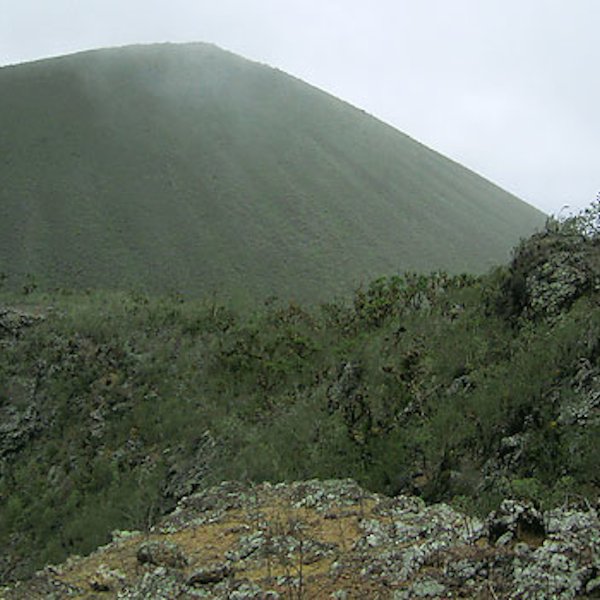
First, a correction to what you will hear around town: Los Gemelos are not craters, and they were not made by a volcano venting. They are sinkholes, formed when the ground collapsed over empty magma chambers beneath it. The result is two huge pits, roughly a mile in diameter and up to 280 meters deep, sitting right beside the main road through the highlands about 20 minutes by car from Puerto Ayora.
The visit:
- Short paths lead to viewpoints over both sinkholes, and a 500-meter trail loops the larger one, an easy hour if you take it slowly.
- The pits are clothed in scalesia forest, the highlands’ signature tree, draped in the garúa mist for much of the dry season. The vegetation down inside the sinkholes is lusher than the road above them because moisture collects below.
- Birding is the real draw: eight of the thirteen Darwin’s finch species are findable here, and the vermilion flycatcher flashes red in the scalesia. Keep an eye out for the short-eared owl, which sometimes hunts the crater edges.
- Entry is with a licensed naturalist guide as part of a highlands tour; taxi tours from Puerto Ayora include it routinely.
The lava tunnels
A short drive away, the lava tunnels of Santa Cruz show the third dimension of the island’s geology. When a lava flow’s surface hardened while molten rock kept running underneath, it drained out and left a tube: some run only a few meters, others stretch for over a mile. The ones open to visitors are walkable, lit in places, and large enough to stand in for their entire length; the biggest require a stairway descent.
Two practical notes from people who have been in: bring a flashlight even on the lit sections (they are not uniformly lit), and expect the floor to be wet and uneven, so closed shoes are not optional. Guides explain the formation sequence and point out the stalactite-like drips of hardened lava, and the stop pairs with El Chato or Rancho Primicias on the same circuit.
Putting the half-day together
The standard highlands tour from Puerto Ayora runs: tortoise reserve (El Chato or Rancho Primicias) in the morning, lava tunnels, Los Gemelos on the return, back in town for lunch. If you are assembling it independently, taxis from Puerto Ayora to the highlands are the normal transport, and the Santa Cruz island guide covers the logistics. Costs for the full trip stack on top of the island’s fixed fees: the $200 park entry for foreign adults and $20 transit card, both explained in the entry fee guide.
Two honest notes for planners. First, the highlands are cool, damp and muddy: shoes with grip, not sandals. Second, Los Gemelos sits on the main road, so tour groups cycle through; early morning or late afternoon visits are quieter.
Why geology nerds should not skip it
Santa Cruz is a dormant shield volcano, and Los Gemelos plus the tunnels are the clearest lesson in how these islands are built that you can access on foot: the sinkholes show the island’s plumbing from above, the tunnels show it from inside, and the fresh lava flows on other islands (Sullivan Bay on Santiago is the extreme) show the raw material. If that sounds like your kind of day, our hiking guide lists the highlands walks, and getting your bearings places Santa Cruz in the archipelago. For how a highlands day fits a land-based itinerary, see cruise vs land.
Last verified: September 2026