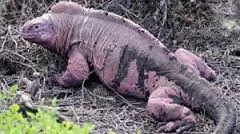
Photo: Rimini (CC BY-SA 3.0) via Wikimedia Commons
Galápagos pink land iguana
Start with the bad news, because most searches end here: you cannot see the pink land iguana. It lives in a single closed zone on the slopes of Wolf Volcano in northern Isabela, and that area is off-limits to tourism; only researchers enter. This page exists so you know what you are missing, why, and which iguana to see instead.
What it is
A species of its own, Conolophus marthae, pink with dark banding, described by science only in 2009 after years of suspicion that the odd pink iguanas park rangers occasionally saw were not just a color variant of the common land iguana. Genetics confirmed it: a lineage older and separate from the yellow land iguanas, numbering roughly 200–300 individuals, all on one volcano slope.
Conservation
Critically Endangered. Everything about the species concentrates risk: one population, one location, small numbers, and a volcano overhead. The 2015 eruption of Wolf Volcano sent lava down its slopes; it missed the iguana zone, but the event is the standing argument for why researchers keep a close watch. Habitat protection, not visitor management, is the whole game here, and the National Park keeps the area closed for exactly that reason.
Where you cannot see it (and what to do instead)
- Wolf Volcano slope, Isabela: closed. No tour, no permit, no exception for visitors.
- The substitute that still delivers: yellow land iguanas at Cerro Dragón on Santa Cruz and the big transferred population on North Seymour, plus the pale Santa Fe land iguana, a separate species, on Santa Fe day trips.
- Wolf Volcano itself appears on some liveaboard dive itineraries as a skyline, not a landing; the northern Isabela cruise routes are in our cruise vs land guide.
Details worth knowing
- Population: 200–300 adults in a single population on Wolf Volcano’s slopes (mark-recapture estimates run 150–270; the first juveniles ever recorded were confirmed in 2021–2024).
- It was the first new large reptile species described in Galápagos in decades, which says how much remains unstudied in the remote north.
- Because the zone is closed, there are no visitor-season recommendations: the species has a calendar, tourism does not.
Why pink?
The coloration is not camouflage — it is the absence of pigment in the skin, revealing the blood vessels and connective tissue underneath. Genetic work published in 2024 confirmed the pink iguana diverged from the common land iguana lineage roughly 5.7 million years ago, making it one of the oldest living lineages in the archipelago, not a recent mutation.
The Wolf Volcano risk
Everything about the species’ survival is concentrated on one slope of one active volcano. The 2015 eruption sent lava flows within a few kilometers of the iguana zone; researchers still do not know how close it came. That is why the National Park keeps the area permanently closed: no buffer, no tourism, no exception. The 2021–2024 expeditions finally confirmed juvenile recruitment — the first evidence the population is breeding successfully in decades — but with 211 individuals (2024 estimate), one lava flow or one feral cat introduction would be terminal.
What you can see instead
| Species | Where | How |
|---|---|---|
| Galápagos land iguana (yellow) | Cerro Dragón, Santa Cruz | Day trip from Puerto Ayora |
| Galápagos land iguana | North Seymour | Cruise itinerary |
| Santa Fe land iguana (pale) | Santa Fe Island | Cruise day trip |
The yellow land iguanas at Cerro Dragón are the closest accessible relative. They share the same body plan, the same burrowing behavior, and the same diet of Opuntia cactus pads. The pink coloration is the only thing you miss.
Last verified: September 2026