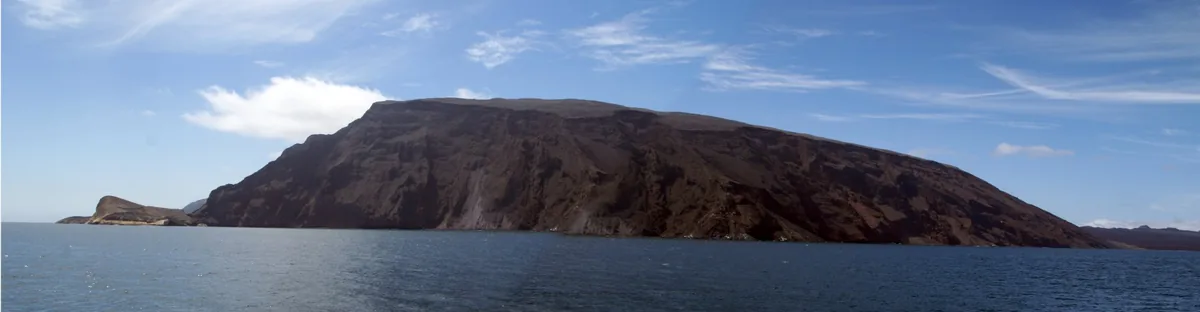
Fernandina island: the youngest, wildest island in Galápagos
Fernandina is what Galápagos looked like before people: the youngest and most volcanically active island, uninhabited, with no introduced species recorded: one of only two islands in the archipelago that can say that (Genovesa is the other). Its lava shoreline supports the biggest marine iguana colonies in the islands and the heart of the flightless cormorant population. Only cruises reach it, almost always on western itineraries paired with Isabela, and for many travelers it is the best day of the trip.
Key facts
- Third largest island by area at 642 km² (248 mi²), and among the youngest in the archipelago: less than one million years old.
- Volcán La Cumbre, which built the island, is still active, one of Galápagos’ most active volcanoes, erupting roughly every five years (2005, 2009, 2018), with a summit crater 6.5 km across.
- Zero permanent human population, and, remarkably, no non-native species ever established.
- Sits directly over the hotspot that created the whole archipelago, which is why it is still growing.
- Access: cruise only. No airport, no ferry, no town. Western-itinerary boats combine it with Isabela across the Bolívar Channel.
The visitor sites, and what you can do at each
Punta Espinosa
The classic Fernandina landing, on the island’s northeast shore with La Cumbre’s lava fields filling the view. The scene: hundreds of marine iguanas stacked on black rock, flightless cormorants drying stubby wings, Galápagos penguins fishing at the water’s edge, and lava cacti sprouting from bare lava. Landings happen only at high tide. Snorkeling here is allowed at the site’s protected edge and is one of the few places you can share the water with marine iguanas. If the iguana pile-up is the photo you came for, this is where it lives.
Punta Mangle
A newer site authorized by the park on the island’s southeast, explored by panga along the mangroves: flightless cormorants, pelicans and finches on the branches, with rays, turtles and sharks in the shallows below.
Cape Douglas and the Bolívar Channel
The waters between Fernandina and Isabela, the Bolívar Channel, are the coldest and richest in the archipelago thanks to upwelling, which is exactly why the cormorants and penguins concentrate here. Whales use the channel too: it is the archipelago’s best whale-watching stretch, especially June to November. Cape Douglas itself is a dive site where cormorants, penguins and marine iguanas (three species found nowhere else on earth) all feed in view of each other.
Wildlife highlights
The flightless cormorant is the signature: the only cormorant on earth that lost the ability to fly, with roughly 1,600 adults remaining, nearly all on Fernandina and the west coast of Isabela; they court and nest most visibly from May to October. The Galápagos penguin, the world’s only penguin north of the equator line of thought aside, is a tropical penguin found only here and on Isabela, with about 2,000 individuals, 95% in these two islands’ waters. Marine iguanas reach their largest size in the archipelago here. Around them: Galápagos hawks circling (Fernandina is one of their strongholds), Galápagos fur seals in the shaded lava grottos, sea lions, and racer snakes — the ones that hunt marine iguana hatchlings in May and June, the scene from the BBC’s Planet Earth II. In 2019 a single Fernandina giant tortoise, “Fernanda”, was found alive 112 years after her species was thought extinct.
How Fernandina is visited
Cruise only, and only on itineraries that commit to the west: the crossing from the central islands takes time, so boats that include Fernandina are typically on 6-day-plus western routes out of Baltra or an 8-day loop. A typical day is Punta Espinosa in the morning (dry landing on lava, naturalist walk, then snorkel) with a Bolívar Channel crossing for whale watching between Fernandina and Isabela sites. There is no land-based alternative and no day tour; if a boat’s itinerary includes Fernandina, that boat has committed to the west.
Standard costs apply: the $200 park entry for foreign adults on arrival and the $20 transit card before flying, covered in the entry fee guide. For choosing a boat that actually reaches the west, our cruise vs land guide and the how many days breakdown are the practical next steps.
Who Fernandina is for
- Wildlife collectors: penguins, flightless cormorants and the biggest marine iguanas in one landing, with hawks overhead. This is the only reliable address for the full set.
- Geology lovers: the youngest lava, an active caldera visible from the water, and the purest “new island” landscape in the archipelago.
- Photographers: texture everywhere: black lava, red crabs, salt-crusted iguanas.
- Not for: land-based travelers (it cannot be done), short 4-to-5-day itineraries (most do not reach the west), or anyone set on beaches and warm-water swimming.
Last verified: September 2026