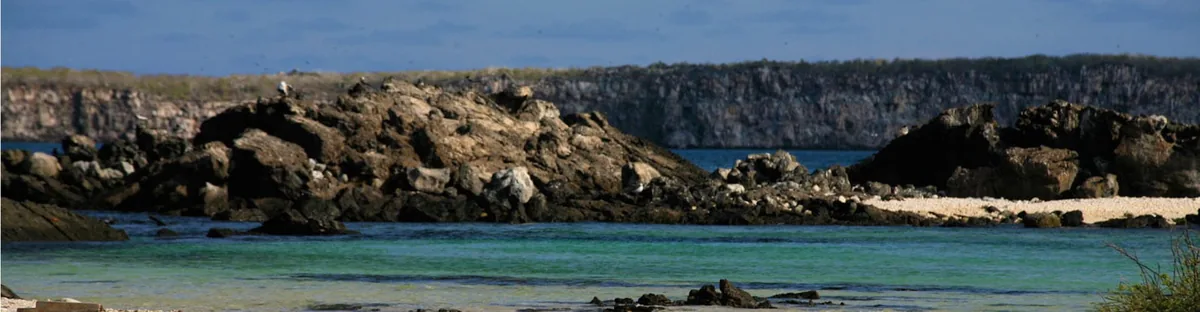
Galápagos in June
June is the month Galápagos changes gears. The warm season ends, the Humboldt current pushes in, and the dry season - garúa season - begins. Air and water cool, the trade winds pick up, and the sea starts to move after months of calm. In exchange, the islands hand you a different cast: humpback whales, the first whale sharks at Darwin and Wolf, giant tortoises marching down to the lowlands to nest, and short-eared owls courting on Genovesa. If you care more about marine life than beach weather, June is where your season starts.
Weather in June
Air averages 26°C high / 21°C low - cooler, and the garúa mist becomes a regular visitor, especially over the highlands, which stay green and damp while the lowlands dry out. Sun still breaks through most days, particularly in the afternoon. Mornings can start grey and cool; pack a light layer instead of assuming tropical heat all day.
Sea conditions in June
The transition month for the water, too. Temperature holds around 23°C by operators’ averages, with satellite surface readings at Puerto Ayora averaging 24.6°C. The bigger change is surface state: the southeast trade winds arrive, swell and currents pick up, and crossings between islands get choppier than the calm-season months. Nothing dramatic yet - July and August build further - but if you’re sensitive to motion, choose a larger or more stable vessel and bring your remedy of choice. Snorkel visibility drops somewhat from the warm-season peak as cooler, plankton-richer water moves in. Wetsuits start to make sense for longer sessions, and rentals are easy to arrange.
Wildlife in June
- Humpback whales arrive (June–September). The season opens this month; the Bolívar Channel between Isabela and Fernandina is the classic lookout, and breaches are a real possibility on western itineraries.
- Whale sharks from late June at Darwin and Wolf. The far-northern islands (dive-liveaboard territory only) start seeing whale sharks as their season begins, and it builds into July and August.
- Giant tortoises descend to the lowlands to nest (June–November). This is the long dry-season ritual: on drier islands the tortoises migrate down from the highlands to lay eggs in the lowlands. You can often follow the dust trails and the tortoises themselves on island roads and trails.
- Short-eared owls court on Genovesa. The courtship window for the Galápagos short-eared owl opens on Genovesa - one of the more unusual sightings in the archipelago.
- Blue-footed boobies continue courting. The May–June courtship stretch carries on at North Seymour and elsewhere.
- Frigatebirds with red pouches linger. The March–June pouch season is closing out, but early June can still show inflated pouches on Genovesa and San Cristóbal.
Who June is good for
- Marine-life travelers. Whales, the first whale sharks, and the cold-water plankton bloom that drives everything.
- Divers. Darwin and Wolf season gets going; cooler water, more pelagics.
- Tortoise people. The lowland nesting migration is a behavior you can actually watch in motion.
- Avoiders of heat and crowds-at-any-price. Cooler air, and demand before the July school-holiday rush.
Who should think twice
- Warm-water purists. The water is cooling and visibility is past its best. If you want bathtub conditions, book February–April.
- Rough-sea-sensitive travelers. Swell and current are rising; choose your boat with stability in mind.
- Land-bird-and-lush-landscape photographers. The lowlands brown out as the dry season settles; the lush, rain-washed look of February–April is gone.
- Albatross courtship seekers. The display peaks April–June but by June the colony is mostly incubating - quieter than April’s spectacle.
Booking advice
June sits just before the July–August demand spike, so availability is generally decent and prices haven’t peaked. Book four to six weeks ahead for good selection, more if you’re set on a specific boat or a dive liveaboard for Darwin and Wolf. Whale-watching hopes belong on western itineraries (Isabela/Fernandina); whale sharks require a dedicated dive liveaboard, a different budget category entirely. On top of your tour, budget the standard fees: the $20 transit control card paid at the mainland airport and the $200 park entry fee collected at Baltra or San Cristóbal - see our guide to entry fees. If you’re weighing June against the rest of the year, our best time to visit Galápagos page lines up all twelve months.
Last verified: September 2026