Photo: © Nicolas Völcker (CC BY-SA 4.0) via Wikimedia Commons
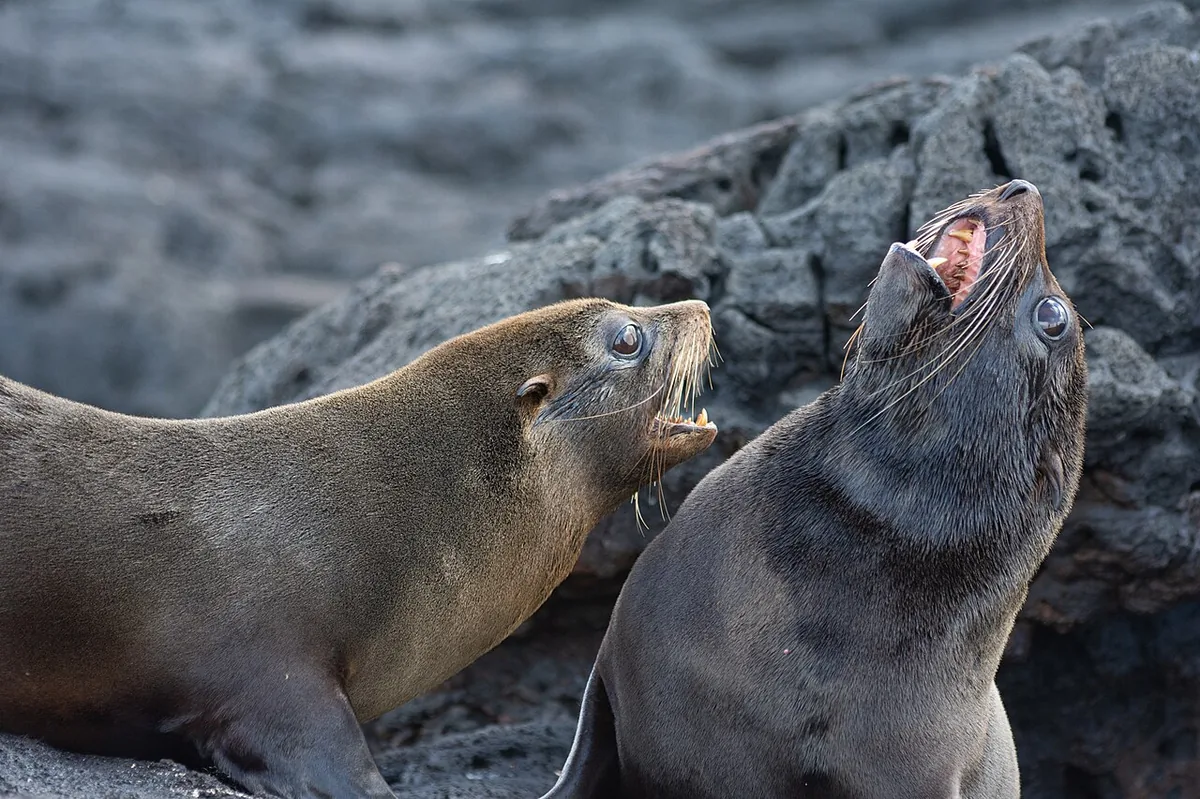
Galápagos fur seal
Not a sea lion, though every first-timer confuses them. The Galápagos fur seal is the smallest of the world’s eared seals, the only one that lives in the tropics, and one of the animals most damaged by our own history: hunted nearly to extinction for its dense fur in the early 20th century, then protected by Ecuadorian law and the creation of the National Park in 1959. Today it is listed Endangered, with a population of roughly 10,000–15,000 individuals concentrated on the western islands where cold upwelling water concentrates fish.
Where to see them
Fur seals favor shaded grottos and rocky coves, and the reliable sites are all western or remote:
- Santiago, Puerto Egas. The best land-based viewing anywhere: the grottos along the coastal trail hold fur seals resting in the lava shade, and the site is a standard central-itinerary stop.
- Isabela west coast. Tagus Cove, Punta Vicente Roca and the Bolívar Channel, where the coldest water is. A small colony sits at Vicente Roca’s cliffs; the island’s other wildlife is in our Isabela guide.
- Genovesa, Darwin Bay. One of the most dependable colonies for visitors on northern itineraries.
- Isabela town side: occasionally at Las Tintoreras and Concha de Perla, though the west coast is their stronghold.
All the strongest populations live along the cold western shores, which is the same water that feeds penguins and flightless cormorants; a western itinerary is the fur seal itinerary.
When to see them
Year-round, but the calendar has one clear peak: pups are born mostly between August and November, and October is the best month to see them, when the rookeries are full of black, woolly pups and the bulls are holding territories. Weaned late, a pup stays with its mother for two to three years, the longest dependency of any seal, which is why mothers look thin in the cool season. Fur seals rest in the shade through midday, so morning and late-afternoon visits see them active; they spend about 70% of their time ashore, more than any other otariid, and they hunt more than 50 m deep, often at night, when their prey rises.
Fur seal or sea lion?
Worth learning before you go, because guides quiz you:
- Fur seals: smaller, with a shorter, blunter head, bigger and protruding eyes, prominent external ears, and fur so dense it is why they were hunted.
- Sea lions: larger, longer-nosed, and social on open beaches; fur seals prefer rocky, shaded retreats and are far less tolerant of crowds.
- Behavior differs too: fur seals are more nocturnal and more solitary, and adult males defend breeding territories so fiercely they do not enter the water to feed until they are near collapse.
Conservation
Endangered, with 10,000–15,000 individuals, and the threats are structural. Historical hunting cut the population hard by the early 1900s; recovery since protection has been real but fragile, because everything concentrates again: one archipelago, western cold-water coasts, and El Niño events that collapse their food. The 1982–83 event was devastating, with some Fernandina colonies losing nearly all pups born that year (one Fernandina colony recorded a single surviving pup of 90). Their preference for shade and rocks keeps them away from most visitor trails, which works in their favor; the 2-metre rule applies, and in the water let them approach you (rules here).
Details worth knowing
- Adult males reach under 5 ft (1.5 m) and around 130 lb (60 kg), tiny by seal standards.
- The densest fur of any seal is the reason they shade-rest all day: overheating is their limit on land.
- Best pup viewing: October, at Puerto Egas and Darwin Bay rookeries.
- They avoid fishing at night more than other seals, a trade-off with sharks that shapes their whole schedule.
Last verified: September 2026