Photo: Gregory "Slobirdr" Smith (CC BY-SA 2.0) via Wikimedia Commons
Dolphins and whales of Galápagos
Some 24 or so cetacean species have been recorded in the waters around Galápagos, and the count peaks with the cold Humboldt season. You do not need a whale-watching tour: sightings happen from the deck of any cruise, with the Bolívar Channel between Isabela and Fernandina as the standout stretch of water. This page covers the species you are most likely to meet, in one place instead of five.
Where and when
The Bolívar Channel, between Isabela and Fernandina, is the single best spot: cold, food-rich upwelling keeps it busy from June to December, and western-island itineraries cross it daily. Bottlenose dolphins ride bows year-round anywhere in the reserve. For the baleen whales, the Humboldt months from June to December are the window, with the strongest concentrations June through November.
Bottlenose dolphin (year-round)
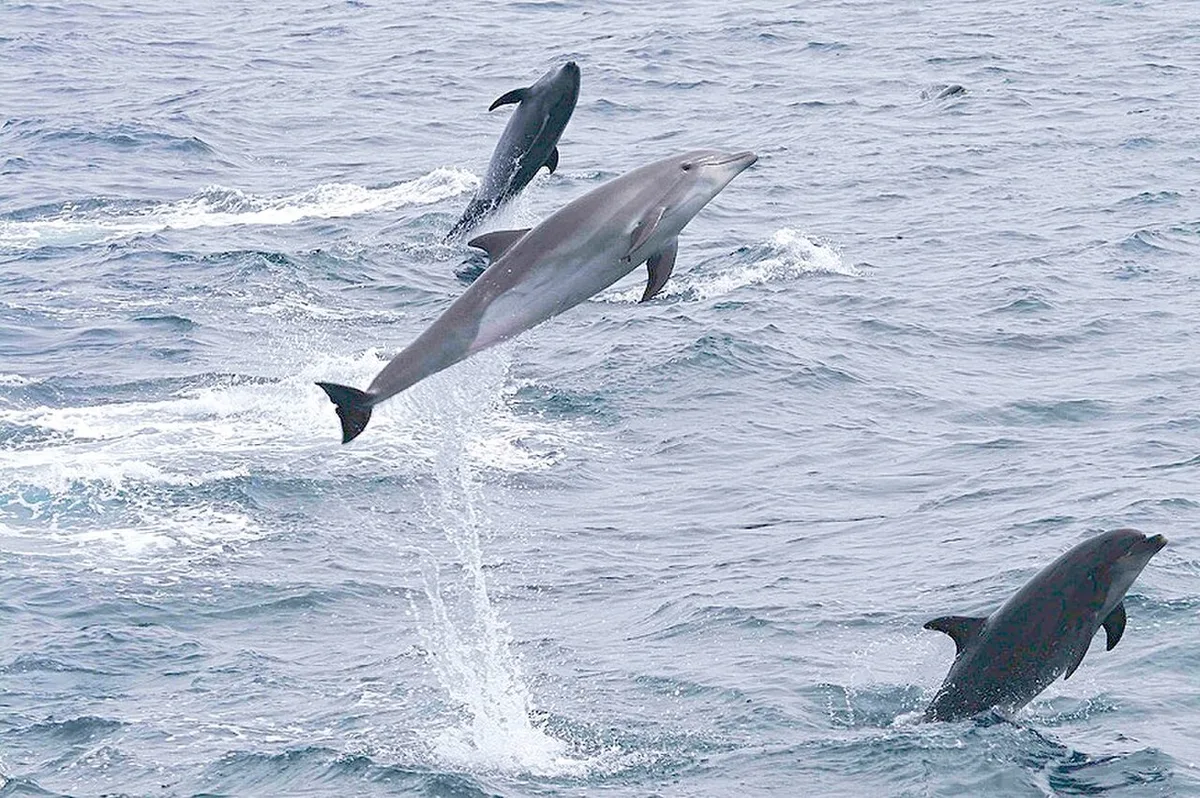
The resident show-off. Bottlenoses and common dolphins are the two most commonly seen of the dolphin species that frequent the islands (GCT also lists spinner dolphins among frequent visitors), and bottlenoses are famous for riding the bow wave of passing boats - if your cruise leaves port and something surfs alongside, this is it. They grow to 2-4 m, can live up to 40 years, and hunt in pods; common (hourglass) dolphins travel in groups of up to 100. Sightings are possible all year, especially from liveaboards crossing open water.
Humpback whale (June-December)
The one that jumps. Humpbacks migrate up from Antarctic feeding waters each dry season, and a 40-tonne animal breaching is visible from a mile off. They hunt cooperatively with bubble nets, a learned technique documented passing between individuals. The Bolívar Channel is the best viewing point, and they also pass Darwin and Wolf on dive itineraries.
Bryde’s whale (June-December)
The only rorqual that stays in equatorial tropical waters year-round, which makes Galápagos waters its home address rather than a stopover. It dives for about two minutes when feeding, and its throat carries up to 70 pleats that expand like an accordion. Identification is genuinely tricky: two to three Bryde’s species are recognized, and they usually travel alone. Bolívar Channel again, June to December.
Sei whale (June-December)
The third-largest rorqual and the fastest whale in the ocean, with bursts up to 31 mph. It migrates into Galápagos’ deep offshore waters each year with the Humboldt to feed, and the honest expectation-setting: sightings are best around Darwin and Wolf, which means a dive liveaboard, and even then a sei whale is a “good day” entry in the log, not a checkbox.
Minke whale (June-December)
The smallest rorqual, up to 10 tonnes, with a pointed snout, hooked dorsal fin and white patches on the flippers. All six of the world’s rorqual species pass through the marine reserve at some point in the year - the blue whale is the largest of that family and the minke the smallest - and minkes migrate in with the Humboldt like the others. Same waters, same window: Bolívar Channel, Darwin and Wolf for liveaboards.
How to maximize your odds
- Book an itinerary that includes the western islands: Isabela and Fernandina mean Bolívar Channel crossings, and that is where the whales concentrate.
- Travel June to November for the baleen whales; dolphins show up any month.
- Spend deck time on crossings, especially morning; guides announce sightings, but half the fun is being the first to shout.
- Orcas: a small resident population hunts sea lions in the west, and sightings are a bonus, never a plan. Sperm whales, once the reason whalers came here, still pass offshore.
A note on the hunting history
Galápagos was one of the world’s prime whaling grounds in the 1800s, and the old Post Office Bay barrel in Floreana is one of the last stops of those crews. The reserve now protects every species on this page, and the population story is one of slow recovery - which is worth remembering when a humpback surfaces next to the panga.
For the sharks that share these waters, see our sharks guide and hammerhead pages; for everything else that flies, our complete birds guide is the index; and the wildlife calendar maps the season month by month.
Last verified: September 2026