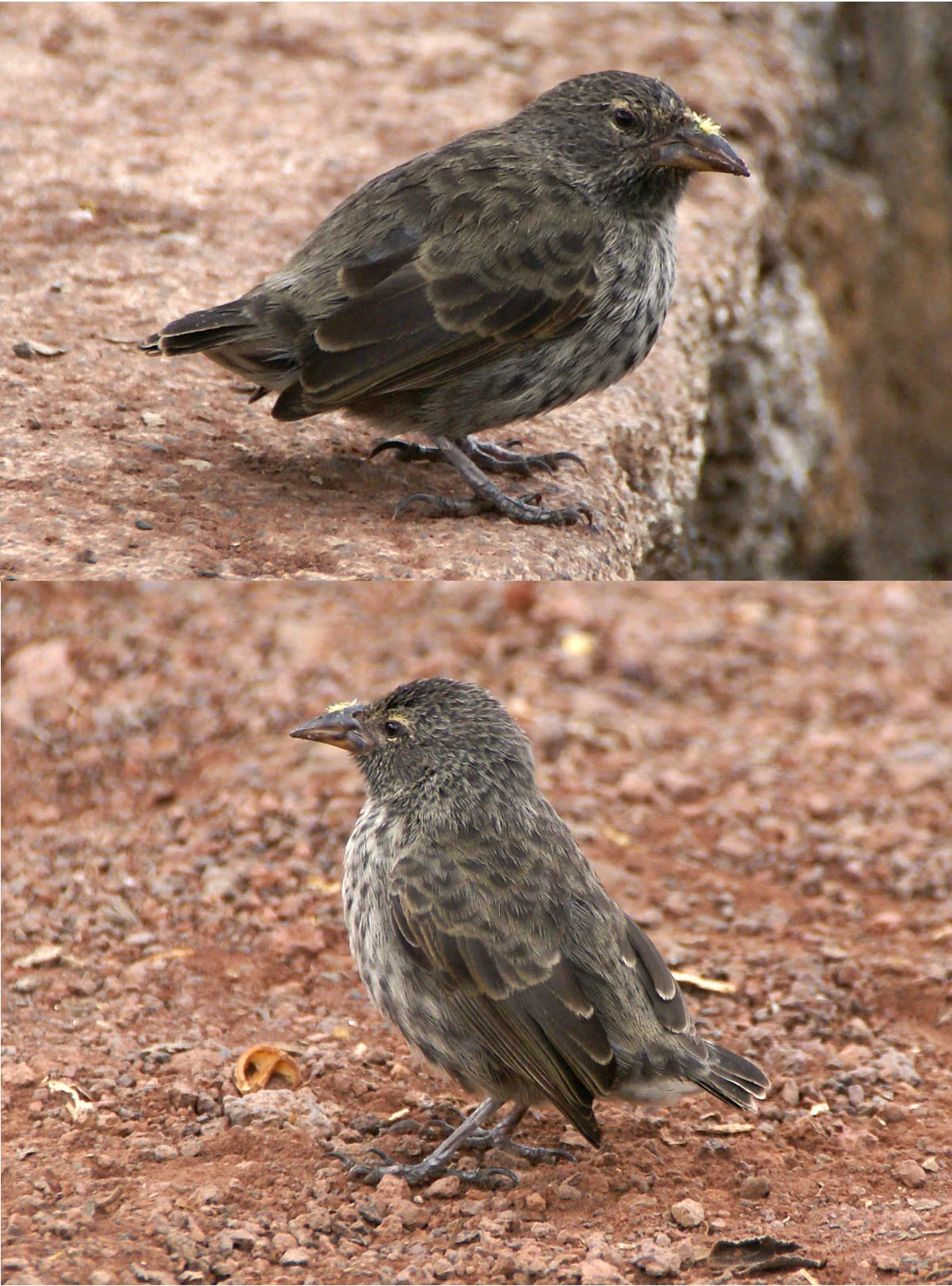
Photo: putneymark (CC BY-SA 2.0) via Wikimedia Commons
Darwin’s finches
The most important small brown birds in the history of science. Darwin collected them in 1835 without realizing what they were; analysis back in England turned them into the textbook case of evolution from a common ancestor, a result DNA testing has since confirmed. Today 13–18 species are recognized depending on the authority (the classic 13 Galápagos land-finches, up to 18 in modern treatments that split the warbler finches and include the Cocos Island finch), and they are one of the few animals you will see on every island you land on.
Where to see them
Everywhere. That is the honest answer, and it makes finch-watching the easiest birding in Galápagos. Still, some sites are better:
- Los Gemelos, Santa Cruz. The collapsed sinkholes in the Scalesia forest hold 8 of the 13 species; the best single site, 20 minutes from Puerto Ayora by car.
- El Chato reserve and the Santa Cruz highlands, plus the Tortuga Bay trail through arid vegetation.
- North Seymour and Santa Fe, for ground and cactus finches alongside the iguanas.
- Daphne Major looms offshore as the finches’ laboratory; it is closed to landings, but boat routes pass it (see our islands guide).
- Wolf and Darwin islands are where the vampire finch lives, on liveaboard dive routes only.
When to see them
Year-round; they never leave. The first rains of the warm season (December–January) trigger breeding activity and song, which makes display season the best observation window. The research calendar matters more than the tourist one: Peter and Rosemary Grant of Princeton have monitored the finches of Daphne Major since 1973, documenting beak shape shifting within a few generations as drought and El Niño years switch the food supply between hard seeds and small soft ones. Evolution here is not a mural; it is measurable year to year.
The beaks tell the story
Each species is defined by beak shape and size, each evolved to a different food: cracking nuts and seeds, probing cactus flowers, picking insects off leaves, even using twigs as tools (the woodpecker finch). Ancestors arrived from the continent, likely grassquits, crossing more than 1,000 km of ocean over 2 million years ago, then split into one species per niche. The extremes get the attention: the sharp-beaked ground finch on Wolf and Darwin, the “vampire finch”, drinks blood from Nazca and blue-footed boobies and rolls eggs until they crack, an adaptation to the driest islands in the group.
Conservation
Not endangered as a group, and some species are abundant, but the picture is uneven: several species are in decline, and the threat is shared, an introduced parasitic fly (Philornis downsi) whose larvae attack nestlings, alongside habitat pressure on the inhabited islands. Research programs run with the National Park to control the fly and protect nests; this is one of the most active conservation projects in the islands right now. Ground rules for any visit are in our park rules page.
Details worth knowing
- The vampire finch is the reason some guides say “do the western itinerary twice”; it exists only on Darwin and Wolf.
- Finches are fearless and noisy. One will unzip your daypack at any picnic table in the highlands; zip locks help, not always.
- Do not fixate on IDing every species in the field. Guides with the birds in hand still argue about boundaries; enjoy the behavior instead.
Last verified: September 2026